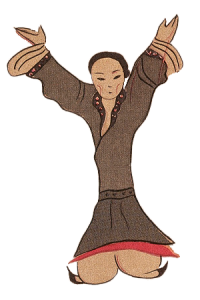
Daoyin teacher, dancer, writer, bodyworker
Eli Halpern was born from a tree stump in 1987. The stump sat in a mossy forest unbothered for hundreds of years before deciding to become, spontaneously, Eli. He generally considers himself a normal guy, except the times when he finds mushrooms growing behind his knees.
Eli’s love of daoyin is rooted in the arts. As a student of painting and poetry, he learned to see the world as form and emptiness. In his twenties, he immersed himself in butoh, a Japanese dance movement that seeks to liberate the primitive body from its social conditioning. This wild art form showed Eli how deep the body goes, and how limitless its expressions can be.
Eli’s path of embodiment took him to tai chi, meditation, and bodywork. It was as a student at Zen Shiatsu Chicago that he first encountered Paulie Zink’s wild animal daoyin.
He quickly learned that daoyin is not just a method—it’s more like a living forest. It flows between wildness and stillness, structure and improvisation. Its elemental movements expand into martial arts, dance, and theater—and yet it is always returning to direct experience, a realm before words.
The study of Daoist cosmology helped Eli put words to the worlds he was exploring. Each day, his curiosity coaxes him onward. The study of history, art, and cultural anthropology offers a through line from ancient China to contemporary America, where the Asian body arts arrived in fragments—a thousand competing techniques stripped of their cultural richness. Daoyin came to fruition in a world where ritual was part of everyday life. Health and fitness were inseparable from art, warfare, and religion.
Despite the social upheavals and cultural mistranslations that have reshaped these arts, they have survived for thousands of years. There is lineage, and there is something yet deeper: the wordless transmission from body to body. By hopping around his living room like a frog, Eli is doing his part to reconnect daoyin with the source of inspiration: the nameless Dao. With gratitude to his teachers, he continues to totter the path, picking up bits and pieces of daoyin in such disparate realms as ballet, improv comedy, and clown.
As a teacher, Eli’s goal is to play and connect with his students. When we allow ourselves to hang-out in the unknown, the body begins to speak. Each one of us contains a wild animal power. To uncover it, we must cultivate softness and openness. When the ground is prepared, growth springs up on its own. It’s totally wuwei!
“Be interested in things!”
Eli lives in Asheville, North Carolina with his bamboo flute, Randy. He likes to walk in the woods and go out dancing. Eli would love to chat with you about art, food, or comedy. He lives by the motto: “Be interested in things!”
Instead of adding to life, simply follow what-is-so-of-itself.
— Zhuangzi
Daoyin Animals
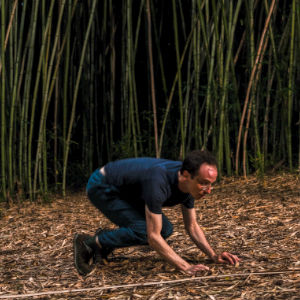
Rabbit
Rabbit combines the springiness of wood with the firmness of metal. Its furry belly is protected by a tightly wound core and solid glutes. Watch out for Rabbit’s unstoppable kick!